I am for the moment struggling with the Noteboom and some Stonewall lines and just note in passing that another review of 'Win with the Stonewall Dutch' has appeared. This time it's John Elburg - a little early with his reviews of August 1st. His review is positive (as they almost always are - even for quite poor books) and contains some useful information for potential buyers. Unfortunately he this time has missed the fact that Ivar Bern is a co-author (mentioning only Sverre Johnsen and Simen Agdestein). It's a pity that Elburg's command of the English language is lacking to the extent that it will be hard to find a complete sentence to quote. My guess is that Gambit on the book's info page will go for:
Conclusion: A very important reference work of the Dutch Stonewall!
Tuesday, July 28, 2009


Friday, July 24, 2009
Stonewall Omissions I
 So far all reviews of 'Win with the Stonewall Dutch' have been very positive. Nevertheless some readers - presumably experienced Dutch players - have expressed disappointment that some lines have been omitted or received insufficient coverage. Some of these reactions are in my opinion very well founded while others appear a bit strange. I will return to the specifics in later entries (my brain is in holyday mode and I don't have a lot of Internet access). However, first I would like to share some thoughts and information about how the size and content of a book is decided.
Our contract with Gambit for 'Win with the Stonewall Dutch' specified that the book should be 192-208 B5 (= large format) pages. This was what the publishers considered the ideal size, taking the intended audience and the book's retail price into account (contrary to what some theory buffs may believe a bigger book may well sell less).
What we actually delivered was the maximum 208 pages plus a little more as we also fully spent the extra 10% that one of Gambit's staff informed us could normally be squeezed in by typographic means. This we did despite knowing perfectly well that the effect might be crowded pages considerably less inviting to the eye than a more spacious lay-out. Thankfully, the result instead was a great looking book of 223 pages. A good deal for the customer but probably not so great for Gambit Publishing who no doubt had to pay extra for printing these extra pages with no possibility to raise their announced price.
My message? Well, just pointing out that in order to add something to the (already oversized) book, we would have had to deduct something too. I am well aware that this could have been done without the book suffering greatly but must say that I am quite fond of what we decided to keep.
Monday, July 20, 2009
First English Reviews
During the week-end there appeared two reviews of 'Win with the Stonewall Dutch'. I'm fairly busy now and they both speak for themselves so I just note that they both are positive and contain very little if any criticism and give the links:
- Marsh Towers is a very nice site which impressively delivers its 100th chess books review.
- I have no idea how many chess books reviews the British Chess Magazine can boast but I guess they top the list. The July Stonewall review is by the editor, John Saunders.
There are also some comments that come quite close to a review at Thomas Johansson's chess book page (this page opens an ad and at least one pop-up). I will return to this as it raises some questions that deserve to be answered.
I will also eventually have a look at some of the questions raised in this thread at Chess Publishing discussion forum.
Friday, July 10, 2009
The Stonewall Reviewed
Another Stonewall review in German is available at Freechess.Info. This review too is very positive. However, curiously it seems more enthusiastic about the Stonewall Defence than about the book. Well, as a matter of fact choosing a fitting subject IS an important part of writing a good book and the Stonewall has a lot of good qualities.
As this still is an English language blog I will attempt another translation (Red = German; Green = English):
Der Stonewall ist schon eine fabelhafte Eröffnung!
Black always sets up the same formation: c6, d5, e6, f5 and Nf6. Then the bishop goes to d6, short castling and off we go (as for instance the game Glücksberg-Najdorf, Warsaw 1935).
Damit die Anwendung des Stonewalls in der Praxis nicht wie das Hornberger Schießen ausgeht (1564 kündigte der Herzog von Württemberg seinen Besuch in Hornberg an. Ein Wächter sollte den Gast per Hornsignal voranmelden, damit man zur Begrüßung Böller- und Kanonendonner abfeuern konnte. Zweimal gab er jedoch falschen Alarm. Als der hohe Gast dann wirklich kam, hatten die Hornberger buchstäblich "ihr Pulver verschossen", und so begrüßten sie den Herzog mit einem lauten "Piff-paff" aus tausend Männerkehlen.) haben Sverre Johnson (sic.), Ivar Bern und Simen Adgestein (sic.) das vor mir liegende Buch geschrieben. Es befasst sich aus der Sicht des Schwarzen mit dieser Eröffnung, die bereits Botwinnik regelmäßig anzuwenden pflegte und die im Repertoire führender Großmeister (Short, Dreev, Moskalenko) zu finden ist.
In order to prevent the practical use of of the Stonewall from outcomes as in the "Hornberg shooting" - a German saying for all bullets being shot elsewhere - Sverre Johnsen, Ivar Bern and Simen Agdestein have written the book which lies in front of me. It examins from Black's viewpoint this opening which already Botwinnik played regularly and which is in the repertoire of leading contemporary grandmasters like Short, Dreev and Moskalenko.
In 12 Kapiteln und mehr als 60 ausgewählten Musterpartien + zusätzlicher theoretischer Übersichten führen die Autoren den Leser an eine leicht zu erlernende Eröffnung heran. In der Tat ist die schwarze Strategie entwaffnend einfach als auch brandgefährlich! In jedem Kapitel gibt es mehrere kommentierte Partien die auf Besonderheiten und wichtige Haupt- und Nebenvarianten hinweisen.
The authors introduce the reader to an easy-to-learn opening in 12 chapters and more than 60 selected Illustrative games and additional theoretical overviews. Black's strategy is actually as simple as it's dangerous! In every chapter there are several annotated games which point out important features as well as main- and sub-variations.
Geschriebenes Wort und Analyse sind wohltuend ausgewogen und strapazieren den Leser nicht unnötig mit ellenlangen Variantenverästelungen. Neueste Entwicklungen wurden genauso berücksichtigt wie vergleichbare Publikationen, ebenso wurden die angefertigten Analysen sorgfältig geprüft und von diversen Engines „abgesegnet“. Im Grunde genommen ist dieses Buch ein komplettes Schwarzrepertoire gegen alles außer 1.e4, die Autoren geben Empfehlungen gegen 1.d4, 1.c4, 1.Sf3 und 1.b3/1.g3.
The prose as well as the analysis are comfortingly well balanced and don't bother the reader unnecessarily with overly long variations. Recent developments as well as comparable publications are taken into account. The resulting variations are carefully tested and checked by various computer engines. The authors give recommendations against 1.d4, 1.c4, 1.Nf3 and 1.b3/1.g3 so in reality this is a complete black repertoire for everything except 1.e4.
Für wen ist das Buch zu empfehlen?
- Für Spieler mit wenig Zeit für das Eröffnungsstudium da im Stonewall das Wissen um Pläne und Strategien wichtiger ist als einzelne Züge.
- Für Spieler, die mit Schwarz um die Initiative kämpfen wollen ohne unnötige Risiken einzugehen.
- Für Spieler, die schon lange auf der Suche nach einem vernünftigen Schwarzrepertoire gegen alles außer 1.e4 sind.
Wie gesagt, der Stonewall ist eine fabelhafte Eröffnung.
Das Buch ist übrigens auch fabelhaft und deswegen ein Daumen hoch von meiner Seite!
For who can this book be recommended?
- For players with little time for opening preparation, as in the Stonewall understanding of plans and strategies is more important than single moves.
- For playes who like to seize the initiative with Black without taking unnecessary risks.
- For players who for a long time have been looking for an opening against everything except 1.e4.
As already said: The Stonewall is a marvellous opening.
The book is incidentally also marvellous and I give it thumbs up!
I hope this translation is not too far off the mark. The text contains some idioms that are unfamiliar to me and help from the readers would be appreciated!
Updated July the 15th:
I have adjusted the translation based on some feed-back from Stephan Busemann. Thanks!
As this still is an English language blog I will attempt another translation (Red = German; Green = English):
Der Stonewall ist schon eine fabelhafte Eröffnung!
Als Nachziehender baut man sich mittels der immer gleichen Anfangszüge c6, d5, e6, f5 nebst Sf6 auf. Anschließend noch flugs den Läufer auf d6 manövriert, kurze Rochade und ab geht die Luzi (wie zum Beispiel in der Partie GLÜCKSBERG - M. NAJDORF Warschau 1935: 1.d4 f5 2.c4 Sf6 3.Sc3 e6 4.Sf3 d5 5.e3 c6 6.Ld3 Ld6 7.0-0 0-0 8.Se2? Sbd7 9.Sg5? L:h2+ 10.Kh1 Sg4 11.f4 De8 12.g3 Dh5 13.Kg2 Lg1 14.S:g1 Dh2+ 15.Kf3 e5! 16.d:e5 Sd:e5+ 17.f:e5 S:e5+ 18.Kf4 Sg6+ 19.Kf3 f4 20.e:f4 Lg4+ 21.K:g4 Se5+ 22.f:e5 h5 0-1 ).
The Stonewall is a marvellous opening!Black always sets up the same formation: c6, d5, e6, f5 and Nf6. Then the bishop goes to d6, short castling and off we go (as for instance the game Glücksberg-Najdorf, Warsaw 1935).
Damit die Anwendung des Stonewalls in der Praxis nicht wie das Hornberger Schießen ausgeht (1564 kündigte der Herzog von Württemberg seinen Besuch in Hornberg an. Ein Wächter sollte den Gast per Hornsignal voranmelden, damit man zur Begrüßung Böller- und Kanonendonner abfeuern konnte. Zweimal gab er jedoch falschen Alarm. Als der hohe Gast dann wirklich kam, hatten die Hornberger buchstäblich "ihr Pulver verschossen", und so begrüßten sie den Herzog mit einem lauten "Piff-paff" aus tausend Männerkehlen.) haben Sverre Johnson (sic.), Ivar Bern und Simen Adgestein (sic.) das vor mir liegende Buch geschrieben. Es befasst sich aus der Sicht des Schwarzen mit dieser Eröffnung, die bereits Botwinnik regelmäßig anzuwenden pflegte und die im Repertoire führender Großmeister (Short, Dreev, Moskalenko) zu finden ist.
In order to prevent the practical use of of the Stonewall from outcomes as in the "Hornberg shooting" - a German saying for all bullets being shot elsewhere - Sverre Johnsen, Ivar Bern and Simen Agdestein have written the book which lies in front of me. It examins from Black's viewpoint this opening which already Botwinnik played regularly and which is in the repertoire of leading contemporary grandmasters like Short, Dreev and Moskalenko.
In 12 Kapiteln und mehr als 60 ausgewählten Musterpartien + zusätzlicher theoretischer Übersichten führen die Autoren den Leser an eine leicht zu erlernende Eröffnung heran. In der Tat ist die schwarze Strategie entwaffnend einfach als auch brandgefährlich! In jedem Kapitel gibt es mehrere kommentierte Partien die auf Besonderheiten und wichtige Haupt- und Nebenvarianten hinweisen.
The authors introduce the reader to an easy-to-learn opening in 12 chapters and more than 60 selected Illustrative games and additional theoretical overviews. Black's strategy is actually as simple as it's dangerous! In every chapter there are several annotated games which point out important features as well as main- and sub-variations.
Geschriebenes Wort und Analyse sind wohltuend ausgewogen und strapazieren den Leser nicht unnötig mit ellenlangen Variantenverästelungen. Neueste Entwicklungen wurden genauso berücksichtigt wie vergleichbare Publikationen, ebenso wurden die angefertigten Analysen sorgfältig geprüft und von diversen Engines „abgesegnet“. Im Grunde genommen ist dieses Buch ein komplettes Schwarzrepertoire gegen alles außer 1.e4, die Autoren geben Empfehlungen gegen 1.d4, 1.c4, 1.Sf3 und 1.b3/1.g3.
The prose as well as the analysis are comfortingly well balanced and don't bother the reader unnecessarily with overly long variations. Recent developments as well as comparable publications are taken into account. The resulting variations are carefully tested and checked by various computer engines. The authors give recommendations against 1.d4, 1.c4, 1.Nf3 and 1.b3/1.g3 so in reality this is a complete black repertoire for everything except 1.e4.
Für wen ist das Buch zu empfehlen?
- Für Spieler mit wenig Zeit für das Eröffnungsstudium da im Stonewall das Wissen um Pläne und Strategien wichtiger ist als einzelne Züge.
- Für Spieler, die mit Schwarz um die Initiative kämpfen wollen ohne unnötige Risiken einzugehen.
- Für Spieler, die schon lange auf der Suche nach einem vernünftigen Schwarzrepertoire gegen alles außer 1.e4 sind.
Wie gesagt, der Stonewall ist eine fabelhafte Eröffnung.
Das Buch ist übrigens auch fabelhaft und deswegen ein Daumen hoch von meiner Seite!
For who can this book be recommended?
- For players with little time for opening preparation, as in the Stonewall understanding of plans and strategies is more important than single moves.
- For playes who like to seize the initiative with Black without taking unnecessary risks.
- For players who for a long time have been looking for an opening against everything except 1.e4.
As already said: The Stonewall is a marvellous opening.
The book is incidentally also marvellous and I give it thumbs up!
I hope this translation is not too far off the mark. The text contains some idioms that are unfamiliar to me and help from the readers would be appreciated!
Updated July the 15th:
I have adjusted the translation based on some feed-back from Stephan Busemann. Thanks!
Wednesday, July 8, 2009
First Stonewall Review
I was expecting John Elburg to be first before British Chess Magazine. But it turned out that Deutscher Fernschachbund (BdF) - the German Correspondence Chess Federation was the first to deliver a regular review of our Stonewall book. The reviewer is very positive (even though he has some reservations regarding the subject. As it's in German here is an attempt to translate (Red = German, Green = English):
Schachbücher aus der Feder von Fernschachspielern sind rar. Dies gilt besonders, wenn der Autor zu den besten in der Welt zählen soll. So ist bei "Win with the Stonewall Dutch" beim Namen der Verfasser ein erstes Ausrufezeichen zu setzen, denn Co-Autor ist Ivar Bern, 17. Fernschach-Weltmeister. Mitverfasser ist Sverre Johnsen, Simen Agdestein hat ebenfalls beigetragen. Die hochgesteckte Erwartung in die Qualität des Werkes, besonders in seine Akkuratesse, wird dann aber beim Lesen des Rückentextes auf die Probe gestellt. Man hat es tatsächlich geschafft, den Namen Ivar Berns in Ivan Bern zu verstümmeln.
Chess books from the pen of correspondence chess players are rare। This is in particular so if the author is among the best in the world. This is the case with " Win with the Stonewall Dutch". The names of the authors earn a first exclamation mark, because the 17. correspondence chess world champion - Ivar Bern - is a co-author. The other co-author is Sverre Johnsen and Simen Agdestein has likewise contributed. However, the high expectations to the quality of the work - in particular its accuracy - are challenged when reading the back text of the book which succeeds in mutilating the name Ivar Bern into Ivan Bern.
Das Material zum holländischen Stonewall aber wird dann sehr solide dargestellt. 64 Partien, fünf davon vom Ex-Weltmeister selbst gespielt (+4, -0, =1). Mit den zwei weiteren Fernschachpartien beträgt deren Anteil insgesamt mehr als zehn Prozent.
The material on the Dutch Stonewall, however, is presented very solidly. Out of 64 games, five are by the Ex-World Champion (+4, -0, =1). Together with two further correspondence games this category altogether totals more than ten per cent.
Der Aufbau der insgesamt 12 Kapitel mutet etwas ungewöhnlich an. Den Anfang macht eine ultra-kurze Übersicht ("Lesson Overview") zum jeweiligen Thema. Dieser folgen mehrere ausführlich kommentierte Partien. Auffälig an diesen Partien ist, dass die Autoren so etwas wie ein FAQ-System eingearbeitet haben. So wie man es von derartigen Systemen kennt, erscheint im Text ein "Q" (für "Question", = Frage) und eine Fragestellung aus der Warte des Lesers, beides kursiv gedruckt. Mal geht es dabei um allgemeine Dinge zum System, dann um spezifische Stellungsfragen und dann wieder um Pläne, Einschätzungen etc. Die Antwort wird jeweils unmittelbar gegeben. Den Partien sowie der diesen nachgestellten Zusammenfassung der aus ihnen abzuleitenden Erkenntnisse schließt sich eine dem Leser gestellte Übung an. Nun erst, das Kapitel abschließend, wird die Theorie in allgemeiner Form dargestellt.
Die Kapitel haben folgende Inhalte:
The structure of the altogether 12 chapters is somewhat unfamiliar. An ultra short overview ('Lesson Overview') introduces the respective topics. These are followed by several games annotated in detail. What is peculiar is that in these games the authors have included something reminding of a FAQ system. As you may recognize from similar systems in the text there appears a "Q" (="Question") and then a question from the viewpoint of a reader, both in italics. Sometimes the question concerns the system in general, at other places specific position or plans, evaluations etc. In each case the answer is directly given. The games and the subsequent summaries of the insights derived from them are followed by exercises for the reader. Only then, closing the chapter, the theory in general form is offered.
The chapters have the following contents:
1. 7. b3: Einführung
2. Das kritische 7. b3 De7 8. Se5!
3. 7. Dc2, 7. Sc3 und seltene 7. Züge
4. 7. Lf4
5. Abspiele mit einem verspäteten Lf4
6. Frühe Abweichungen
7. 4. c4 mit Sh3
8. 2. c4: Abspiele ohne Fianchetto
9. 2. Sf3: Abspiele ohne Fianchetto
10. 2. Sc3 und 2. Lg5
11. Staunton-Gambit und seltene zweite Züge
12. 1. c4, 1. Sf3 und 1. g3.
{translation of the Table of Content}
Den Abschluss des Werkes bilden die Lösungen auf die Übungen in den einzelnen Kapiteln, ein Varianten- und ein Spielerverzeichnis.
The book concludes with the solution to the exercizes from the previous chapters and indexes of variations and players.
Die abschließende Einschätzung des Rezensenten zum Werk soll in dessen eigenen FAQ-Stil erfolgen: F: Sind Sie der Ansicht, dass dieses Buch zum Kauf empfohlen werden kann? Ja, dieser Ansicht bin ich. Es gibt einen umfassenden Überblick über den holländischen Stonewall und zeichnet sich durch einen genügenden Tiefgang aus. Wenn der Partieerfolg des Lesers ausbleiben sollte, wird dies an dessen eigenen Fehlern und vielleicht auch dem nicht ganz gesunden Eröffnungssystem liegen, nicht aber an "Win with the Stonewall Dutch".
The reviewer's concluding evaluation of the work will be in its own FAQ style:
Q: Is it your opinion that this book can be recommended to buy? Yes, this is my opinion. The book offers a comprehensive overview over the Dutch Stonewall and is also sufficiently deep. If the reader isn't happy with his results, he must blame his own mistakes or a opening system that may not be completely sound, but not " Win with the Stonewall Dutch".
I am not entirely happy with this translation so quite likely I will try to improve it one of the first days.
Updated July the 15th and July the 24th:
I adjusted the translation based on some feed-back from Stephan Busemann on the 15th of July and again on the 24th due to his explanation. Thanks!
Schachbücher aus der Feder von Fernschachspielern sind rar. Dies gilt besonders, wenn der Autor zu den besten in der Welt zählen soll. So ist bei "Win with the Stonewall Dutch" beim Namen der Verfasser ein erstes Ausrufezeichen zu setzen, denn Co-Autor ist Ivar Bern, 17. Fernschach-Weltmeister. Mitverfasser ist Sverre Johnsen, Simen Agdestein hat ebenfalls beigetragen. Die hochgesteckte Erwartung in die Qualität des Werkes, besonders in seine Akkuratesse, wird dann aber beim Lesen des Rückentextes auf die Probe gestellt. Man hat es tatsächlich geschafft, den Namen Ivar Berns in Ivan Bern zu verstümmeln.
Chess books from the pen of correspondence chess players are rare। This is in particular so if the author is among the best in the world. This is the case with " Win with the Stonewall Dutch". The names of the authors earn a first exclamation mark, because the 17. correspondence chess world champion - Ivar Bern - is a co-author. The other co-author is Sverre Johnsen and Simen Agdestein has likewise contributed. However, the high expectations to the quality of the work - in particular its accuracy - are challenged when reading the back text of the book which succeeds in mutilating the name Ivar Bern into Ivan Bern.
Das Material zum holländischen Stonewall aber wird dann sehr solide dargestellt. 64 Partien, fünf davon vom Ex-Weltmeister selbst gespielt (+4, -0, =1). Mit den zwei weiteren Fernschachpartien beträgt deren Anteil insgesamt mehr als zehn Prozent.
The material on the Dutch Stonewall, however, is presented very solidly. Out of 64 games, five are by the Ex-World Champion (+4, -0, =1). Together with two further correspondence games this category altogether totals more than ten per cent.
Der Aufbau der insgesamt 12 Kapitel mutet etwas ungewöhnlich an. Den Anfang macht eine ultra-kurze Übersicht ("Lesson Overview") zum jeweiligen Thema. Dieser folgen mehrere ausführlich kommentierte Partien. Auffälig an diesen Partien ist, dass die Autoren so etwas wie ein FAQ-System eingearbeitet haben. So wie man es von derartigen Systemen kennt, erscheint im Text ein "Q" (für "Question", = Frage) und eine Fragestellung aus der Warte des Lesers, beides kursiv gedruckt. Mal geht es dabei um allgemeine Dinge zum System, dann um spezifische Stellungsfragen und dann wieder um Pläne, Einschätzungen etc. Die Antwort wird jeweils unmittelbar gegeben. Den Partien sowie der diesen nachgestellten Zusammenfassung der aus ihnen abzuleitenden Erkenntnisse schließt sich eine dem Leser gestellte Übung an. Nun erst, das Kapitel abschließend, wird die Theorie in allgemeiner Form dargestellt.
Die Kapitel haben folgende Inhalte:
The structure of the altogether 12 chapters is somewhat unfamiliar. An ultra short overview ('Lesson Overview') introduces the respective topics. These are followed by several games annotated in detail. What is peculiar is that in these games the authors have included something reminding of a FAQ system. As you may recognize from similar systems in the text there appears a "Q" (="Question") and then a question from the viewpoint of a reader, both in italics. Sometimes the question concerns the system in general, at other places specific position or plans, evaluations etc. In each case the answer is directly given. The games and the subsequent summaries of the insights derived from them are followed by exercises for the reader. Only then, closing the chapter, the theory in general form is offered.
The chapters have the following contents:
1. 7. b3: Einführung
2. Das kritische 7. b3 De7 8. Se5!
3. 7. Dc2, 7. Sc3 und seltene 7. Züge
4. 7. Lf4
5. Abspiele mit einem verspäteten Lf4
6. Frühe Abweichungen
7. 4. c4 mit Sh3
8. 2. c4: Abspiele ohne Fianchetto
9. 2. Sf3: Abspiele ohne Fianchetto
10. 2. Sc3 und 2. Lg5
11. Staunton-Gambit und seltene zweite Züge
12. 1. c4, 1. Sf3 und 1. g3.
{translation of the Table of Content}
Den Abschluss des Werkes bilden die Lösungen auf die Übungen in den einzelnen Kapiteln, ein Varianten- und ein Spielerverzeichnis.
The book concludes with the solution to the exercizes from the previous chapters and indexes of variations and players.
Die abschließende Einschätzung des Rezensenten zum Werk soll in dessen eigenen FAQ-Stil erfolgen: F: Sind Sie der Ansicht, dass dieses Buch zum Kauf empfohlen werden kann? Ja, dieser Ansicht bin ich. Es gibt einen umfassenden Überblick über den holländischen Stonewall und zeichnet sich durch einen genügenden Tiefgang aus. Wenn der Partieerfolg des Lesers ausbleiben sollte, wird dies an dessen eigenen Fehlern und vielleicht auch dem nicht ganz gesunden Eröffnungssystem liegen, nicht aber an "Win with the Stonewall Dutch".
The reviewer's concluding evaluation of the work will be in its own FAQ style:
Q: Is it your opinion that this book can be recommended to buy? Yes, this is my opinion. The book offers a comprehensive overview over the Dutch Stonewall and is also sufficiently deep. If the reader isn't happy with his results, he must blame his own mistakes or a opening system that may not be completely sound, but not " Win with the Stonewall Dutch".
I am not entirely happy with this translation so quite likely I will try to improve it one of the first days.
Updated July the 15th and July the 24th:
I adjusted the translation based on some feed-back from Stephan Busemann on the 15th of July and again on the 24th due to his explanation. Thanks!
Monday, June 29, 2009
Repertoire Choices and Consistency
Sometimes interesting thoughts and debates deserving to be read 'get hidden' in the comments to old entries. In this blog entry one anonymous reader (it's hard to say how many of the 'Anonymous' are the same poster) is generally very positive to our book. However, he points out a missing move-order option and some related challenges.
Dealing with transpositional options is an eternal challenge for repertoire books. A good repertoire may well be inconsistent if you in a certain position have a choice between a move X that will lead to a position you have to face anyway (by transposition) and a move Y which may be better but takes some effort to analyse. Going for move X is rational as it saves you some labour but in chess your first priority should be to play the best move.
Whether you should go for the independent option (Y) or not, must depend on at least three factors:
 Here we mention 7.b3 Qe7 and now:
- 8.Bb2 (when play may continue 8...b6 9.Ne5) and
- 8.Ne5 (when 8...0-0 9.Bb2 b6 is a possibility).
However, there also is a related possibility:
- 7.Ne5 0-0 8.b3!? (when 8...Qe7 9.Bb2 b6 transposes to the lines above).
We agree that this is a natural move, and although it is very rare and not tested in high-level encounters, it deserved a mention. An author should not only look at what has been played by strong players but also scan the position for other 'normal looking moves', trying to foresee what his readers may wonder at.
The anonymous reader concludes that in order to have a consistent repertoire against all of White's various combinations of b3 and Ne5, it's necessary to play ...b6 lines against all of them. I disagree with that conclusion. A completely ...b6 based solution is certainly possible, and fully recommended if you trust your analysis after 7.b3 Qe7 8.Ne5 0-0 9.Bb2 b6!? 10.cxd5 exd5. However, this line is based on untested analysis and it's also possible to meet each of the three lines with a specific reply, even if only one of them involves an early ...b6:
a) 7.b3 Qe7 8.Bb2 b6 9.Ne5 Bb7! which has for a long time been considered fine for Black.
b) 7.b3 Qe7 8.Ne5 0-0 9.Bb2 Nbd7!? planning ...a5 (as Moskalenko does).
c) 7.Ne5 0-0 8.b3 Nbd7(!), securing an edge in development and planning ...dxc4 followed ...e5.
As a matter of fact, even if I am tempted to go for the ...b6 solutions, against line c) I would seriously consider 8...Nbd7 as it seems strategically simpler.
Lessons to be learned
Dealing with transpositional options is an eternal challenge for repertoire books. A good repertoire may well be inconsistent if you in a certain position have a choice between a move X that will lead to a position you have to face anyway (by transposition) and a move Y which may be better but takes some effort to analyse. Going for move X is rational as it saves you some labour but in chess your first priority should be to play the best move.
Whether you should go for the independent option (Y) or not, must depend on at least three factors:
- How satisfied are you with the positions resulting from move X?
- How much better can move Y really be?
- How complicated are the variations following move Y?
 Here we mention 7.b3 Qe7 and now:
- 8.Bb2 (when play may continue 8...b6 9.Ne5) and
- 8.Ne5 (when 8...0-0 9.Bb2 b6 is a possibility).
However, there also is a related possibility:
- 7.Ne5 0-0 8.b3!? (when 8...Qe7 9.Bb2 b6 transposes to the lines above).
We agree that this is a natural move, and although it is very rare and not tested in high-level encounters, it deserved a mention. An author should not only look at what has been played by strong players but also scan the position for other 'normal looking moves', trying to foresee what his readers may wonder at.
The anonymous reader concludes that in order to have a consistent repertoire against all of White's various combinations of b3 and Ne5, it's necessary to play ...b6 lines against all of them. I disagree with that conclusion. A completely ...b6 based solution is certainly possible, and fully recommended if you trust your analysis after 7.b3 Qe7 8.Ne5 0-0 9.Bb2 b6!? 10.cxd5 exd5. However, this line is based on untested analysis and it's also possible to meet each of the three lines with a specific reply, even if only one of them involves an early ...b6:
a) 7.b3 Qe7 8.Bb2 b6 9.Ne5 Bb7! which has for a long time been considered fine for Black.
b) 7.b3 Qe7 8.Ne5 0-0 9.Bb2 Nbd7!? planning ...a5 (as Moskalenko does).
c) 7.Ne5 0-0 8.b3 Nbd7(!), securing an edge in development and planning ...dxc4 followed ...e5.
As a matter of fact, even if I am tempted to go for the ...b6 solutions, against line c) I would seriously consider 8...Nbd7 as it seems strategically simpler.
Lessons to be learned
- Being 'too consistent' - trying to transpose whenever possible - may cost you some advantageous options.
- Transpositions rarely are just transpositions; normally there is a trade of options. You stop some options and allow others.
Tuesday, June 23, 2009
Noteboom RAM
 For several reasons (which I may disclose later) I have become interested in the Noteboom variation. The variation can occur from several move-orders but one of the more common is 1.d4 d5 2.c4 e6 3.Nc3 c6 4.Nf3 dxc4 5.a4 Bb4 6.e3 b5 7.Bd2 a5 8.axb5 Bxc3 9.Bxc3 cxb5 10.b3 Bb7 11.bxc4 b4: (Dia)
The position is extremely unbalanced and it looks like a position where a lot of RAM will be very useful. I suspect that objectively White is at least somwhat better. But in order to make use of his chances he must know what he is doing. Black scores very well in my database - probably because in most games he is the more experienced Noteboom player.
I am no expert on the line but would like to collect some essential games and annotate them on this blog. My annotations will mainly be based on van der Vorm and van der Werf's out-of-print monograph and Rybka's output.
Some candidate games so far are:
- Kasparov-Tyomkin, Tel Aviv (sim) 1994 and
- Oei-Van Wissen, Leeuwarden open 1993, illustrating White’s attacking possibilities supported by his huge pawn centre.
- Lin Weiguo-Stangl, Beijing 1995, illustrating the power of Black’s connected queenside passers.
- Thieme-Van der Worm, Leidschendam 1994, showing why White should be careful meeting ...e5 with dxe5.
Could any readers help me with more (or better) candidate games - in particular recent ones with at least one strong player involved?
Monday, June 22, 2009
The Stonewall Has Reached Norway
Finally I got my hands on a physical copy of 'Win With the Stonewall Dutch'!
It arrived in the mail today together with 12 other copies and looked exactly as well as I had hoped. Wolff Morrow's artwork on the cover adds considerably to the first impression. There's a tournament in my club so it didn't take me long to get rid of most of the copies. Now I have one for my own library and one for my mother's collection.
I have not yet had the time to check with our correction list but it seems that almost all of our last minute additions made it to the print files. Thanks to editor Graham Burgess and type-setter Petra Nunn!
I was not so happy to spot 3 typos. Fortunately they were all fairly minor and none of them will confuse the reader or influence his repertoire or understanding in any way. I have an agreement with Gambit not to publish any updates or corrections to the book so I will not disclose them now. However, one of them is quite annoying so I will ask the publishers to correct it in an entry here (in a suitable context). One of the typos was missed by all proof reading eyes. Another I believe made it to the printer outside the normal proof-reading process. The third and most annoying one probably crept into the book as a result of the proof-reading/final checking.
It arrived in the mail today together with 12 other copies and looked exactly as well as I had hoped. Wolff Morrow's artwork on the cover adds considerably to the first impression. There's a tournament in my club so it didn't take me long to get rid of most of the copies. Now I have one for my own library and one for my mother's collection.
I have not yet had the time to check with our correction list but it seems that almost all of our last minute additions made it to the print files. Thanks to editor Graham Burgess and type-setter Petra Nunn!
I was not so happy to spot 3 typos. Fortunately they were all fairly minor and none of them will confuse the reader or influence his repertoire or understanding in any way. I have an agreement with Gambit not to publish any updates or corrections to the book so I will not disclose them now. However, one of them is quite annoying so I will ask the publishers to correct it in an entry here (in a suitable context). One of the typos was missed by all proof reading eyes. Another I believe made it to the printer outside the normal proof-reading process. The third and most annoying one probably crept into the book as a result of the proof-reading/final checking.
Monday, June 15, 2009
More Stonewall RAM
The Maroczy-Tartakower game was excluded from our Stonewall book mainly because it didn't really match our recommended repertoire. Today's game might have made it had it been in the databases (or had my memory been a bit more consistent). I only remembered it when annotating Tartakower's brilliancy. The reason it is missing in BigBase/MegaBase may be that the game information is unreliable. Different sources offer different years and different spellings for White's name. As for tournament/event I have no idea.

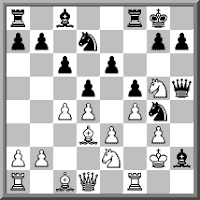

Glinksberg - Najdorf
Warsaw 1928
1.d4 f5 2.c4 Nf6 3.Nc3 e6 4.Nf3 d5?!
4...Bb4 is fine for Black.
5.e3
As mentioned elsewhere 5.Bf4 is very good for White.
5...c6
Black can more safely reach this position from the move-order 4.e3 d5 5.Nf3 c6.
6.Bd3 Bd6 7.0–0 0–0 (Dia)
This position is fairly attractive for Black who has won a number of short games.
8.Ne2!?
This move has been criticized but probably wrongly so as Beliavsky has played it recently. Our book only mentions 8.b3 and 8.Qc2. Another option is 8.Ne5, planning the stodgy counter-Stonewall with 9.f4.
8...Nbd7
A more recent game went 8...Ne4 9.Ne1 b6 10.f3 Nf6 11.cxd5 cxd5 12.Bd2 Qd7 13.Rc1 Ba6 14.Qb3 Rc8 15.Rxc8+ Qxc8 16.Bb4 Bc4 17.Qa3 Bxb4 18.Qxb4 Nc6 and Black was fine in Beliavsky-Vydeslaver, Kallithea 2008. It is symptomatic that Beliavsky couldn't win against his presumably weaker opponent.
9.Ng5? Bxh2+!
This isn't quite as simple as it seems. Black must have calculated quite far or trusted that the neccessary resources would present themselves as play developed.
10.Kh1
The obvious point was 10.Kxh2? Ng4+ and Black wins an important pawn. Now he threatens to trap the bishop with g3 as well as Nxe6.
10...Ng4 11.f4 Qe8 12.g3 Qh5 13.Kg2 (Dia)

White is now ready to pick up the bishop with moves like Nf3 and Rh1.
13...Bg1! 14.Nxg1
Any other capture loses immediately.
14...Qh2+ 15.Kf3 e5!
This is the key to Black's combination. The threat is ...e4 so White has no choice.
16.dxe5 Ndxe5+!
Remarkably Black succeeds in sacrificing all his minor pieces in this game which has been called 'The Polish Evergreen' (or Immortal or something like it).
17.fxe5 Nxe5+ 18.Kf4 Ng6+ 19.Kf3 (Dia)

In early calculations it may have been reassuring for Black to have a draw as a back-up. But does he actually have anything more than a repetition?
19...f4!
This obviously lets the light-squared bishop into the game. What's less obvious is that the rook too joins the attack.
20.exf4 Bg4+! 21.Kxg4 Ne5+! 22.fxe5 h5# 1–0
Lesson to be Learned:
Never underestimate Black's light-squared bishop in the Stonewall.
Sunday, June 14, 2009
Another Stonewall Extract
I am scanning the web for reviews of our new Stonewall book. So far I have found nothing, and I don't really expect anything resembling a review for a couple of weeks yet. Nevertheless there turned up something interesting.
For some weeks now, Gambit has offered a pdf extract from 'Win with the Stonewall Dutch'. Today I noticed that Niggemann offers another extract from the book. I have not figured out how to link directly to the relevant page but if you go to their homepage, then choose Online-Shop and Neuigkeiten, scroll down to the Stonewall book, click it and then choose 'Katalog', you will find my entire Preface. The text is a bit confusing as there are first two paragraphs from the publisher's blurb and then my text starts without any heading or explanation. The extract from the Preface starts with the sentence: 'I have for a long time been fascinated and mystified by the Stonewall Dutch'.
For some weeks now, Gambit has offered a pdf extract from 'Win with the Stonewall Dutch'. Today I noticed that Niggemann offers another extract from the book. I have not figured out how to link directly to the relevant page but if you go to their homepage, then choose Online-Shop and Neuigkeiten, scroll down to the Stonewall book, click it and then choose 'Katalog', you will find my entire Preface. The text is a bit confusing as there are first two paragraphs from the publisher's blurb and then my text starts without any heading or explanation. The extract from the Preface starts with the sentence: 'I have for a long time been fascinated and mystified by the Stonewall Dutch'.
Wednesday, June 10, 2009
A Silly Little Move
From time to time I add another small chapter to my Veresov manuscript. Whether it will ever become a chess book I have no idea. One deciding factor will be the analytical conclusion of some critical lines. However, occasionally I start looking at moves that really don't belong in a serious chess book. That's when I turn to this blog.
A couple of days ago I started looking at 1.d4 Nf6 2.Nc3 d5 3.Bg5 Nbd7 4.a3?!. (Dia)
 The reason I even noticed the possibility was Giddins' very readable 'How to Build Your Chess Opening Repertoire' in which he mentions the line 4.f4!? e6 5.a3!?, a speciality of British correspondence expert A.M. Steward.
4.a3 appears a silly move but after 4...c5 5.dxc5 it’s not at all clear that Black can win his pawn back. The position arising after 4...e6 5.e4 (5.f4 transposes to Steward's line) 5...dxe4 6.Nxe4 Be7 7.Nxf6+ Bxf6 8.Bxf6 Qxf6 (Dia) must be worse for White than similar French lines (Burn and Rubinstein) but may still be somewhat easier to play for White:

a) 9.Qd2 c5 10.Nf3 0–0 11.0–0–0 cxd4 12.Qxd4 Qxd4 13.Rxd4 += Schinzel-Pinkas, Bydgoszcz 1976.
b) 9.Nf3 0–0 10.Qe2 (10.Be2 e5! is at least equal for Black) 10...c5 11.0–0–0 cxd4 12.Rxd4 e5 13.Rd2 Re8 14.Qe3 a6 15.Be2 Qe7 16.Bc4 h6 17.Re1 += Schweber-Quinteros, Villa Martelli 1996.
Whether you find such positions attractive or not is to some extent a matter of taste. From a practical viewpoint it must be taken into account that some black players may dislike them. Quite possibly Black must look into the untested 4...c6 or 4...h6 if he is looking for a more interesting path to equality.
Rubbish? I honestly don't know, but now I can with a clear conscience exclude these lines from my manuscript!
A couple of days ago I started looking at 1.d4 Nf6 2.Nc3 d5 3.Bg5 Nbd7 4.a3?!. (Dia)
 The reason I even noticed the possibility was Giddins' very readable 'How to Build Your Chess Opening Repertoire' in which he mentions the line 4.f4!? e6 5.a3!?, a speciality of British correspondence expert A.M. Steward.
4.a3 appears a silly move but after 4...c5 5.dxc5 it’s not at all clear that Black can win his pawn back. The position arising after 4...e6 5.e4 (5.f4 transposes to Steward's line) 5...dxe4 6.Nxe4 Be7 7.Nxf6+ Bxf6 8.Bxf6 Qxf6 (Dia) must be worse for White than similar French lines (Burn and Rubinstein) but may still be somewhat easier to play for White:


a) 9.Qd2 c5 10.Nf3 0–0 11.0–0–0 cxd4 12.Qxd4 Qxd4 13.Rxd4 += Schinzel-Pinkas, Bydgoszcz 1976.
b) 9.Nf3 0–0 10.Qe2 (10.Be2 e5! is at least equal for Black) 10...c5 11.0–0–0 cxd4 12.Rxd4 e5 13.Rd2 Re8 14.Qe3 a6 15.Be2 Qe7 16.Bc4 h6 17.Re1 += Schweber-Quinteros, Villa Martelli 1996.
Whether you find such positions attractive or not is to some extent a matter of taste. From a practical viewpoint it must be taken into account that some black players may dislike them. Quite possibly Black must look into the untested 4...c6 or 4...h6 if he is looking for a more interesting path to equality.
Rubbish? I honestly don't know, but now I can with a clear conscience exclude these lines from my manuscript!
Tuesday, June 9, 2009
Another Step Forward

Today I noticed that 'Win with the Stonewall Dutch' has been promoted from 'Forthcoming Books' to 'New Gambit Chess Books'. There is no more information about distribution in Europe and the US, but I assume that will be added soon.
I really look forward to holding it my hands. Not only because I love books - and my own in particular - but also because I am curious how much of our last minute additions actually made it into the book.
Friday, May 29, 2009
Stonewall RAM
What makes a strong player, and how can you best improve your playing strength?
Opinions vary and there obviously are more than one ingredient. However, most authorities agree that one essential requirement is to understand a certain number of positions and games really well. This is the main message of two interesting books:
It goes without saying that knowing a certain number of games related to your opening repertoire is a particularly important part of your chess education. This obviously is one of the ideas behind the 'Illustrative Games' concept which dominates modern opening books.
'Win with the Stonewall Dutch' offers 64 illustrative games which are all quite close to the book's recommended repertoire for Black. However, there of course are many other games containing useful Stonewall ideas which don't quite fit into our recommended repertoire.
Among the 59 games listed in Ziyatdinov's book there is a Stonewall game that didn't make it to our Stonewall book but deserves to be studied. Myself I first saw it in Reti's 'Die Meisters des Schachbretts':
Maroczy - Tartakower, Teplitz Schoenau 1922
1.d4 e6 2.c4 f5 3.Nc3 Nf6 4.a3?!
This is a little too slow. Black will not play ...Bb4 as long as White can meet it with e3 and Nge2.
4...Be7
Our Stonewall book concentrates on lines with ...Bd6 rather than ...Be7.
5.e3
The Dutch is normally more attractive for Black when White avoids the g3 systems - partly because he can more easily develop his queenside but also because White's kingside tends to be more vulnerable.
5...0–0 6.Bd3 d5
The Stonewall formation. Also development with ...b6 is quite attractive against early e3 lines.
7.Nf3 c6
This too generally is a part of the Stonewall set-up. In this position it may not be strictly necessary but Black is preparing to redeploy his bishop to d6.
8.0–0 Ne4
This is a part of the ancient attacking plan formerly associated with the Stonewall. Black starts attacking on the kingside with a knight, a bishop, two major pieces and possibly a couple of pawns while his queenside is left dormant.
9.Qc2 Bd6
This is the best position for Black's dark-squared bishop once White's exchanging options Bf4 or Ba3 have been eliminated. The loss of a tempo has little significance because of White's slow mobilization.
10.b3 Nd7 11.Bb2 (Dia)
 This is a fairly typical Stonewall position with e3 rather than g3.
11...Rf6
This is the old-fashioned Stonewall attack. Black goes directly for the king, leaving his queenside pieces undeveloped.
12.Rfe1 Rh6 13.g3 Qf6 14.Bf1 g5
The g-pawn is an important attacking unit. The weaknesses left behind are not important if Black can just keep his initiative going.
15.Rad1 g4 16.Nxe4 fxe4 17.Nd2 (Dia)
 If White can only find the time to play Bg2 and Nf1 his kingside will be quite safe and he will be ready to attack the queenside.
17...Rxh2!?
If Black had been better mobilized this would have been a standard sacrifice, hardly worth a diagram.
18.Kxh2 Qxf2+ 19.Kh1
Black now has no forcing follow up to his rook sacrifice. What makes the game remarkable is how he now quietly goes on completing his queenside development. White is free to reorganize his defence but seems unable to find a satisfactory plan. It would have been interesting to see what a Karpov or Petrosian would have come up with but Rybka's evaluation of '=+ (-0.44)' may well be correct (and in any case indicates that modern software is capable of appreciating positional compensation).
19...Nf6
19...Qxg3 20.Re2 Nf6 transposes.
20.Re2 Qxg3 21.Nb1 Nh5 22.Qd2 Bd7 23.Rf2 Qh4+ 24.Kg1 Bg3 (Dia)
 Finally it seems clear that Black must have more than compensation for his material investment.
25.Bc3
Rybka gives 25.Rg2 Rf8 26.Nc3 Rf3 27.Bc1 Ng7 =+.
25...Bxf2+ 26.Qxf2 g3 27.Qg2 Rf8
Black has got his material back without giving up his attack. White is lost.
28.Be1 Rxf1+ 29.Kxf1 e5 30.Kg1 Bg4 31.Bxg3 Nxg3 32.Re1 Nf5 33.Qf2 Qg5 34.dxe5 Bf3+ 35.Kf1 Ng3+ 0–1
Opinions vary and there obviously are more than one ingredient. However, most authorities agree that one essential requirement is to understand a certain number of positions and games really well. This is the main message of two interesting books:
It goes without saying that knowing a certain number of games related to your opening repertoire is a particularly important part of your chess education. This obviously is one of the ideas behind the 'Illustrative Games' concept which dominates modern opening books.
'Win with the Stonewall Dutch' offers 64 illustrative games which are all quite close to the book's recommended repertoire for Black. However, there of course are many other games containing useful Stonewall ideas which don't quite fit into our recommended repertoire.
Among the 59 games listed in Ziyatdinov's book there is a Stonewall game that didn't make it to our Stonewall book but deserves to be studied. Myself I first saw it in Reti's 'Die Meisters des Schachbretts':
Maroczy - Tartakower, Teplitz Schoenau 1922
1.d4 e6 2.c4 f5 3.Nc3 Nf6 4.a3?!
This is a little too slow. Black will not play ...Bb4 as long as White can meet it with e3 and Nge2.
4...Be7
Our Stonewall book concentrates on lines with ...Bd6 rather than ...Be7.
5.e3
The Dutch is normally more attractive for Black when White avoids the g3 systems - partly because he can more easily develop his queenside but also because White's kingside tends to be more vulnerable.
5...0–0 6.Bd3 d5
The Stonewall formation. Also development with ...b6 is quite attractive against early e3 lines.
7.Nf3 c6
This too generally is a part of the Stonewall set-up. In this position it may not be strictly necessary but Black is preparing to redeploy his bishop to d6.
8.0–0 Ne4
This is a part of the ancient attacking plan formerly associated with the Stonewall. Black starts attacking on the kingside with a knight, a bishop, two major pieces and possibly a couple of pawns while his queenside is left dormant.
9.Qc2 Bd6
This is the best position for Black's dark-squared bishop once White's exchanging options Bf4 or Ba3 have been eliminated. The loss of a tempo has little significance because of White's slow mobilization.
10.b3 Nd7 11.Bb2 (Dia)
 This is a fairly typical Stonewall position with e3 rather than g3.
11...Rf6
This is the old-fashioned Stonewall attack. Black goes directly for the king, leaving his queenside pieces undeveloped.
12.Rfe1 Rh6 13.g3 Qf6 14.Bf1 g5
The g-pawn is an important attacking unit. The weaknesses left behind are not important if Black can just keep his initiative going.
15.Rad1 g4 16.Nxe4 fxe4 17.Nd2 (Dia)
 If White can only find the time to play Bg2 and Nf1 his kingside will be quite safe and he will be ready to attack the queenside.
17...Rxh2!?
If Black had been better mobilized this would have been a standard sacrifice, hardly worth a diagram.
18.Kxh2 Qxf2+ 19.Kh1
Black now has no forcing follow up to his rook sacrifice. What makes the game remarkable is how he now quietly goes on completing his queenside development. White is free to reorganize his defence but seems unable to find a satisfactory plan. It would have been interesting to see what a Karpov or Petrosian would have come up with but Rybka's evaluation of '=+ (-0.44)' may well be correct (and in any case indicates that modern software is capable of appreciating positional compensation).
19...Nf6
19...Qxg3 20.Re2 Nf6 transposes.
20.Re2 Qxg3 21.Nb1 Nh5 22.Qd2 Bd7 23.Rf2 Qh4+ 24.Kg1 Bg3 (Dia)
 Finally it seems clear that Black must have more than compensation for his material investment.
25.Bc3
Rybka gives 25.Rg2 Rf8 26.Nc3 Rf3 27.Bc1 Ng7 =+.
25...Bxf2+ 26.Qxf2 g3 27.Qg2 Rf8
Black has got his material back without giving up his attack. White is lost.
28.Be1 Rxf1+ 29.Kxf1 e5 30.Kg1 Bg4 31.Bxg3 Nxg3 32.Re1 Nf5 33.Qf2 Qg5 34.dxe5 Bf3+ 35.Kf1 Ng3+ 0–1
Friday, May 22, 2009
Win with the 3...Qd6 Scandinavian
I am currently recovering from an apathetic period following the completion of our Stonewall book and am starting to consider what may be a fitting next book project. One interesting subject is the Scandinavian (1.e4 d5) and in particular the 3...Qd6 variation. There are some thoughts on this line in the comments to this entry. But I am still not convinced it will stand thorough top-level testing.
1.e4 d5 2.exd5 Qxd5 3.Nc3 Qd6!? (Dia)

In recent years this seems to overshadow the old mainline 3...Qa5. Quite recently there has been a second edition of Michael Melts' 'Scandinavian Defense: The Dynamic 3...Qd6'. The book is a treasure chest containing an enormous amount of well organized information on the line and lots of independent analysis. Unfortunately it's also very hard to navigate and contains very little prose or guidance except for a few introductory chapters.

4.d4 Nf6
For some minor (possibly insignificant) reasons I prefer 4...a6 - usually followed by 5...Nf6.
5.Nf3
5.g3!? is an alternative move-order with some independent ideas.
5...a6
I find this a much more attractive move than ...c6. Black may follow up with ...Nc6, ...Bg4 and 0-0-0 but also ...b5, ...Bb7 and ...e6.
6.g3
This seems to be the new mainline. White not only makes ...b5 less attractive but also prepares Bf4.
6...Bg4 7.Bg2
7.h3 is another important option.
7...Nc6 8.0–0
Black also needs to prepare for the immediate 8.d5.
8...0–0–0 9.d5!?
Again the immediate 9.Bf4 must be considered.
9...Ne5! (Dia)

This is Melts recommendation (Game 18, page 151, line B2e2d2!) and indeed the move is starting to look forced:
a) 9...Nxd5 10.Nxd5 Qxd5 11.Qxd5 Rxd5 12.Ng5 of Lakos-R.Perez, Ortigueira 2002 is entirely unattractive for Black.
b) 9...Nb4 is a more optimistic approach, forcing White to choose between a repetition and complications. Unfortunately the complications seem close to winning for White: 10.h3 Bh5 11.Bf4 Qc5 12.Be3 Qd6 13.Qe2! Nbxd5 14.Nxd5 Nxd5 15.Rad1! Qf6 and White has a pleasant choice:
b1) 16.Bd4 Qe6 17.Qxe6+ fxe6 18.Be5 Bxf3 19.Bxf3 c6 20.Bg4 Nc7 21.Rxd8+ Kxd8 22.Rd1+ +- Ibarra Jerez-Trent, Chalkidiki 2003.
b2) 16.c4 Nxe3 (16...Nb4 17.Rxd8+ Kxd8 18.Rd1+ Kc8 19.Qd2 Qd6 20.Qe1 Qf6 21.g4 Qxb2 22.Rb1 +- Humphrey-Aplin, Kuala Lumpur 2006) 17.Rxd8+ Kxd8 18.Qxe3 c6 19.g4 Bg6 20.Qb6+ Kc8 21.Rd1 e5 22.Nxe5 +- Rasik-Antoniewski, Czechia 2006.
10.Bf4
The queen sacrifice 10.Nxe5!? is enterprising but on closer scrutiny doesn't seem too terrifying:
a) 10...Qxe5 11.f3 Be6 12.Re1 Qf5 13.f4 Qg6 14.Re5 Bf5 = Ninov-Panbukchian, Pleven 2005.
b) 10...Bxd1 11.Nxf7 Bxc2 12.Nxd6+ exd6 13.Re1 Re8 14.Be3 g6 15.Rac1 Bf5 16.Ne2 Bg7 17.Nd4 Ng4 18.Nxf5 gxf5 = Ragger-Nikolov, Kranj 2004.
10...Nxf3+ 11.Bxf3 Bxf3 12.Qxf3 e5 13.dxe6 Qxe6 14.Bg5 (Dia)

This seems to be the crucial position. Black has tried a number of different moves but none seem to give full equality:
a) 14...Qc6 15.Qxc6 bxc6 16.Bxf6 gxf6 17.Rad1 Bb4 18.Ne2 Bd2 19.Kg2 +=
b) 14...h6 15.Rfe1 Qb6 16.Nd5 (16.Bxf6 Qxf6 17.Qxf6 gxf6 18.Re4 Bc5 19.Rae1 Rd2 20.R1e2 Rxe2 21.Rxe2 Bd4 22.Re7 Bxc3 23.bxc3 += Tukhaev-Vasiliev, Evpatoria 2006) 16...Rxd5 17.Bxf6 Qc6 18.c4 Rd6 19.Qxc6 Rxc6 20.Re8+ Kd7 21.Rd8+ Ke6 22.Bc3 +/- Mardell-Brandt, Taby 2007.
d) 14...Bd6 15.Rfe1 Be5 16.Ne4 (16.Re2 Rde8 17.Rae1 Nd7 18.Bf4 f6 19.Qe3 g5 20.Bxe5 Nxe5 = Stiri-Dounis, Athens 2007; 16.Bf4 Nd7 17.Nd5 f6 18.c4 g5 19.Bd2 h5 20.Ba5 Qg4 = Williams-Hamad, Turin 2006) 16...Rhe8 17.Nc5 Qd5 18.Qxd5 Rxd5 19.Bxf6 gxf6 20.Nd3 Re6 21.f4 Bd6 22.Rad1 += Huerga Leache-Garcia Paolicchi, La Massana 2008.
c) 14...Bb4 15.Rfe1 Qb6 16.Bxf6 gxf6 17.Nd5 (is 17.Rfe1 better?) 17...Rxd5 18.Qxd5 Bxe1 19.Rxe1 Qxb2 20.Qxf7 Kb8 = Pesotsky-Bazarov, Lipetsk 2008.
e) 14...h5 15.Bxf6 (15.Rfe1 Qg4 16.Qxg4+ hxg4 17.Ne4 Nxe4 18.Rxe4 f6 = Sedina-Danielian, Elista 2004) 15...Qxf6 16.Qxf6 gxf6 17.Rad1 Bd6 (17...Bc5 18.Ne4 Be7 19.Rfe1 Rhe8 20.Nc3 c6 21.Rxd8+ Kxd8 22.Kg2) 18.Nd5 h4 19.Kg2 Rh5 20.b3 b5 21.Rfe1 += Fernando-Galego, Vila Real 2005.
Preliminary conclusion:
This line may attract a (semi) professional player who feels confident that he can hold a draw against well prepared opponents in one of the lines after 14.Bg5. However, for the average club player (who represents the main segment of chess book buyers) defending a slightly inferior endgame like this for several dozens of moves sounds like a nightmare and will not be a good selling point.
Monday, May 18, 2009
Win with the Stonewall Dutch Finally Completed

Exactly one week ago I sent a final minor correction (one single letter actually) to Gambit Publishing and now our book is at the printers. The total number of corrections were considerable:
- 126 corrections/additions - including some references to recent games.
- 20 suggestions for how to make room for those changes that required more space.
- 8 suggestions/questions, mainly regarding the English language.
- 5 replies to the editor regarding information given in the manuscript.
Updated information on the book can be found at Gambit's information page for the book. The book will be 224 B5 pages (not 208 as previously announced) and will be available in June. I have no inside information about printing time but my guess would be quite early in June.
There is a pdf-sample available for download. There, in addition to some pages from Lesson 4, the Table of Content can be found:
4 Symbols
4 Bibliography
5 Preface
6 Foreword
8 Stonewall Invitation
15 Lesson 1 7 b3: Introduction
36 Lesson 2 The Critical 7 b3 Qe7 8 Ne5!
54 Lesson 3 7 Qc2, 7 Nc3 and Rare 7th Moves
67 Lesson 4 7 Bf4
89 Lesson 5 Lines with a Delayed Bf4
100 Lesson 6 Early Deviations
117 Lesson 7 4 c4 with Nh3
145 Lesson 8 2 c4: Non-Fianchetto Lines
156 Lesson 9 2 Nf3: Non-Fianchetto Lines
169 Lesson 10 2 Nc3 and 2 Bg5
183 Lesson 11 The Staunton Gambit and Rare 2nd Moves
195 Lesson 12 1 c4, 1 Nf3 and 1 g3
211 Solutions to Exercises
222 Index of Variations
223 Index of Players
Wednesday, April 15, 2009
A Comfortable Stonewall
It's always nice to end a tournament with a win (and it makes it easier to resist the next opportunity to play). My opponent was another Norwegian. Actually I think he participated in the very first tournament I played outside my club, more than 30 years ago. He is considerably lower rated than me, so a win wouldn't improve my tournament result much - but a loss or even a draw would cost me dearly.
Haveland - Sv.Johnsen
Thailand Open 2009 (9)
1.d4 f5
I was quite happy when my opponent played 1.d4 as now the position is quite unbalanced already.
2.Nf3 e6 3.g3 Nf6 4.Bg2 d5
The Stonewall. I considered a more flexible system, possibly increasing my winning chances but I know there are lots of winning potential even in rather stale looking Stonewall positions.
5.c4 c6 6.cxd5?!
This is not that bad a move but it's harmless in the extreme.
6...exd5 7.0–0 Bd6 8.Nc3 0–0 9.Rb1
White plans a minority attack with b4-b5. Two other moves with similar aims are 9.a3 and 9.Qc2.
9...Ne4 10.e3
White sensibly decides to stop ...f4 but weakens his light squares somewhat. There are not many games with this position played at an international level. In the following game at least Black is 2400+: 10.Nxe4 fxe4 11.Bg5 Qe8 12.Nd2 h6 13.Be3 Nd7 14.b4 Nf6 15.Qb3 Bf5 16.b5 Qh5 =+ Weng Tianlun-Wang Yue, Suzhou 2001.
10...Nd7 11.Qc2 Qe7 12.Nd2
This appears to be the first new move in the game. Hamrakulova-Ambrosi, Wch Girls U18 Chalkidiki 2003 was drawn after 12.a3 Nb6 13.Ne1 Be6 14.Nd3 Bf7 15.b4 Nc4 16.Re1 Ng5 17.Qd1 Rae8 18.Rf1 Qf6 19.Nc5 Qe7 20.Nd3 Qf6 21.Nc5 Qe7 22.Nd3 Qf6 23.Nc5.
12...Ndf6 13.Ndxe4 fxe4 14.Bd2 Bg4
I briefly considered 14...b6 but wasn't sure how well I would stand even if my opponent overlooked my threat, e.g. 15.f3 Ba6 16.fxe4 Bxf1 17.Rxf1 dxe4 18.Nxe4 and White may even be better.
15.f3 exf3 16.Bxf3 Rae8 17.Rbe1 Bh3 18.Bg2 Qd7 (D)
 I have completed my development but was not sure how to go ahead. Fortunately my opponent now forces the play, saving me some difficult desicions.
19.e4?
As my opponent pointed out, 19.a3 would have been a very useful preparation for this central break - at least after my most natural replies, 19...a5 and 19...Re7 - simply because there then will be no pawn to pick up on a2.
19...Bxg2 20.Kxg2 dxe4 21.Nxe4 Nxe4 22.Rxf8+ Bxf8 23.Rxe4 Qd5 24.Kf3 (D)
 This position arises more or less by force as a consequence of White's 19th move.
24...Rxe4
I looked carefully for a permanent bind/zugzwang but didn't see anything really convincing so I grabbed the pawn. When checking with Rybka it produced this line: 24...g5! 25.g4 (25.a3 g4+) 25...Bd6 26.h3 Kg7 27.a3 a5 28.a4 h6 29.Be1 b6 30.Ke3 Bf4+ 31.Kf3 Kg6 which looks quite promising (Rybka says '-+ -1.61'.) but it refuses to tell me how I actually convert it to a full point.
25.Qxe4 Qxa2 26.Bc3 Qf7+
Simpler and stronger is 26...Qd5 27.Ke3 Qxe4+ 28.Kxe4 Kf7 29.d5 c5.
27.Ke3 Bd6 28.Qg4 Kf8 29.Kd3 Qg6+
I assumed this must be a win despite my doubled pawns and White's active king.
30.Qxg6 hxg6 31.d5 c5 32.Kc4 a6 33.Ba5 b5+ 34.Kd3 Kf7 35.b3 (D)

35...Kf6 36.Ke4 Ke7 37.Bc3 Kf7 38.Ba5 Kf8 39.Kf3 Be7
Finally my two pieces have found positions from which I can make progress.
40.Bb6 Ke8 41.h3 Kd7 42.Ke4 Kd6 43.Ba5 Bf6 44.g4 g5?
This stupid advance creates a weakness and prolongs the game with at least 10 moves.
45.Be1 Be5 46.Bd2 Bf6 47.Be1 g6 48.Bg3+ Kd7 49.Kd3
49.Bf2 c4 50.bxc4 bxc4 51.Bb6 Kd6 doesn't make much difference.
49...a5 50.Be1 Bd8 51.Bc3 Kd6 52.Ke4 c4 53.bxc4 bxc4 54.Bb2 Kc5
54...Bb6 is equally good as 55.Ba3+ Bc5 56.Bxc5+ Kxc5 57.Ke5 c3 58.d6 c2 59.d7 c1Q 60.d8Q Qe3+ 61.Kf6 Qd4+ is winning.
55.Ba3+ Kb5 56.Kd4
56.d6 Ka4 57.Bc1 Kb3 58.Kd5 c3 doesn't change anything.
56...Bf6+ 57.Ke4 Ka4 58.Bc1 Kb3 59.d6 a4 60.Kd5 c3 61.Be3 c2 62.Ke6 Bd8 63.Kd7 Ba5 64.Bxg5 a3 0–1
Haveland - Sv.Johnsen
Thailand Open 2009 (9)
1.d4 f5
I was quite happy when my opponent played 1.d4 as now the position is quite unbalanced already.
2.Nf3 e6 3.g3 Nf6 4.Bg2 d5
The Stonewall. I considered a more flexible system, possibly increasing my winning chances but I know there are lots of winning potential even in rather stale looking Stonewall positions.
5.c4 c6 6.cxd5?!
This is not that bad a move but it's harmless in the extreme.
6...exd5 7.0–0 Bd6 8.Nc3 0–0 9.Rb1
White plans a minority attack with b4-b5. Two other moves with similar aims are 9.a3 and 9.Qc2.
9...Ne4 10.e3
White sensibly decides to stop ...f4 but weakens his light squares somewhat. There are not many games with this position played at an international level. In the following game at least Black is 2400+: 10.Nxe4 fxe4 11.Bg5 Qe8 12.Nd2 h6 13.Be3 Nd7 14.b4 Nf6 15.Qb3 Bf5 16.b5 Qh5 =+ Weng Tianlun-Wang Yue, Suzhou 2001.
10...Nd7 11.Qc2 Qe7 12.Nd2
This appears to be the first new move in the game. Hamrakulova-Ambrosi, Wch Girls U18 Chalkidiki 2003 was drawn after 12.a3 Nb6 13.Ne1 Be6 14.Nd3 Bf7 15.b4 Nc4 16.Re1 Ng5 17.Qd1 Rae8 18.Rf1 Qf6 19.Nc5 Qe7 20.Nd3 Qf6 21.Nc5 Qe7 22.Nd3 Qf6 23.Nc5.
12...Ndf6 13.Ndxe4 fxe4 14.Bd2 Bg4
I briefly considered 14...b6 but wasn't sure how well I would stand even if my opponent overlooked my threat, e.g. 15.f3 Ba6 16.fxe4 Bxf1 17.Rxf1 dxe4 18.Nxe4 and White may even be better.
15.f3 exf3 16.Bxf3 Rae8 17.Rbe1 Bh3 18.Bg2 Qd7 (D)
 I have completed my development but was not sure how to go ahead. Fortunately my opponent now forces the play, saving me some difficult desicions.
19.e4?
As my opponent pointed out, 19.a3 would have been a very useful preparation for this central break - at least after my most natural replies, 19...a5 and 19...Re7 - simply because there then will be no pawn to pick up on a2.
19...Bxg2 20.Kxg2 dxe4 21.Nxe4 Nxe4 22.Rxf8+ Bxf8 23.Rxe4 Qd5 24.Kf3 (D)
 This position arises more or less by force as a consequence of White's 19th move.
24...Rxe4
I looked carefully for a permanent bind/zugzwang but didn't see anything really convincing so I grabbed the pawn. When checking with Rybka it produced this line: 24...g5! 25.g4 (25.a3 g4+) 25...Bd6 26.h3 Kg7 27.a3 a5 28.a4 h6 29.Be1 b6 30.Ke3 Bf4+ 31.Kf3 Kg6 which looks quite promising (Rybka says '-+ -1.61'.) but it refuses to tell me how I actually convert it to a full point.
25.Qxe4 Qxa2 26.Bc3 Qf7+
Simpler and stronger is 26...Qd5 27.Ke3 Qxe4+ 28.Kxe4 Kf7 29.d5 c5.
27.Ke3 Bd6 28.Qg4 Kf8 29.Kd3 Qg6+
I assumed this must be a win despite my doubled pawns and White's active king.
30.Qxg6 hxg6 31.d5 c5 32.Kc4 a6 33.Ba5 b5+ 34.Kd3 Kf7 35.b3 (D)

35...Kf6 36.Ke4 Ke7 37.Bc3 Kf7 38.Ba5 Kf8 39.Kf3 Be7
Finally my two pieces have found positions from which I can make progress.
40.Bb6 Ke8 41.h3 Kd7 42.Ke4 Kd6 43.Ba5 Bf6 44.g4 g5?
This stupid advance creates a weakness and prolongs the game with at least 10 moves.
45.Be1 Be5 46.Bd2 Bf6 47.Be1 g6 48.Bg3+ Kd7 49.Kd3
49.Bf2 c4 50.bxc4 bxc4 51.Bb6 Kd6 doesn't make much difference.
49...a5 50.Be1 Bd8 51.Bc3 Kd6 52.Ke4 c4 53.bxc4 bxc4 54.Bb2 Kc5
54...Bb6 is equally good as 55.Ba3+ Bc5 56.Bxc5+ Kxc5 57.Ke5 c3 58.d6 c2 59.d7 c1Q 60.d8Q Qe3+ 61.Kf6 Qd4+ is winning.
55.Ba3+ Kb5 56.Kd4
56.d6 Ka4 57.Bc1 Kb3 58.Kd5 c3 doesn't change anything.
56...Bf6+ 57.Ke4 Ka4 58.Bc1 Kb3 59.d6 a4 60.Kd5 c3 61.Be3 c2 62.Ke6 Bd8 63.Kd7 Ba5 64.Bxg5 a3 0–1
The Scandinavian Variation
My 8th game was a painful loss against a young Singaporean boy:
Wee Che En - Sv. Johnsen
Thailand Open 2009 (8)
1.e4 e5 2.Nf3 Nc6 3.Bb5 a6 4.Ba4 Nf6 5.0–0 Be7 6.Re1 b5 7.Bb3 d6 8.c3 0–0 9.h3 a5!?
This was what I had prepared against 1.e4 for this tournament. I like to call it the Scandinavian variation but may well be the only one to do so.
10.a4 b4 11.d4 bxc3 12.bxc3 exd4 13.cxd4 (D)

13...d5!
This is Black's idea in the 10.a4 line. Now it looks a little like a Open Ruy Lopez with Black controlling b4.
14.e5 Ne4 15.Nbd2
15.Re3 Nb4 16.Nc3 Bb7 17.Ne2 Kh8 18.Ba3 f6 19.Nf4 Ra6 20.Bxb4 axb4 21.Bxd5 Bxd5 22.Nxd5 Qxd5 23.Qd3 Nc5 24.dxc5 Qxd3 25.Rxd3 fxe5 = Castillo-Bolbochan, Mar del Plata 1950.
15...Bf5 16.Ba3!?
I didn't remember having ever seen this move and thought it looked a little funny. But when consulting my notes I had actually analyzed a GM game with it.
16...Bxa3
The game I had analysed went 16...Nb4 17.Nf1 c5 18.Ne3 Be6 19.Bxb4 axb4 20.dxc5 Bxc5 21.Qd3 Rc8 22.Rad1 Bb6 and Black was clearly better in Hellers-Kupreichik, Malmo 1987. The big question is whether these moves ever entered my mind or if they only appeared on my screen with Rybka doing the thinking. In earlier days I always played through my notes on a chess board (frequently a pocket set but a full size board if circumstances permitted me). It is too time consuming for my present life situation, but far better for memorization.
17.Rxa3 Nb4 18.Ra1 c6
I tried to calculate 18...Nd3 19.Re3 and now I looked at 19...Ndxf2 20.Qe2 Nxd2 21.Nxd2 Ne4 as well as 19...Nexf2 20.Qe2 and decided against the entire variation as I didn't find the resulting positions particularly clear. After the game I was pleased to see that Rybka agreed in this evaluation. That being said, the move I played probably reveals my lack of understanding for this kind of positions. It seems that Black in similar positions play a quick ...c5 with active piece play. Instead I tried to stabilize the queenside, hoping to create kingside chances with ...f6 at some point. This may be sufficient for equality but demands quite exact play.
19.Qe2 Rb8 20.Rec1 h6 21.Qe3 Kh8 22.Nxe4 Bxe4 23.Nd2 Bh7 24.Rc3 Qe7 25.Bd1 f6 26.f4 fxe5 27.fxe5 Rf7 28.Nf3 Rbf8 29.Qd2 Be4 30.Be2 Rf4 31.Rf1
For the last dozen of moves I as well as my opponent have played quite decent chess. My problem was that I didn't quite appreciate my opponent's play and felt that I should be looking for an advantage. Instead my small weaknesses on a5 and c6 were slowly beginning to be felt. So rather than accepting that I had to fight for equality, I played a somewhat desperate move:
31...g5?
It is tempting to add another question mark as this move isn't only weakening; it's also completely unprovoked.
32.Rc5 Qc7 33.Nh2!
This move I had completely missed.
33..Rxf1+ 34.Bxf1 Rf4 35.Ng4 Qd8
Probably 35...Kg7 36.Nf6 Bg6 is a somewhat better attempt to keep my position together.
36.Nf6 Bg6 37.Be2 Qb6 38.g3 Rf5 39.Qe3! Na2? (D)

Objectively this is a losing error but as my position is creaking in its seams anyway, I only give it one question mark. Actually I considered '?!' as it forces White to calculate a fairly long line.
40.Bd3 Qb3 41.Rxa5!
This wins as does 41.Rxc6.
41...Nb4 42.Ra8+ Kg7 43.Rg8+ Kf7 44.e6+ Kxf6
44...Ke7 45.Rg7+ Kxf6 46.Rxg6+ Ke7 47.Rg7+ comes to exactly the same.
45.Rxg6+ Ke7 46.Rg7+ Ke8 47.e7!
The move I overlooked when I played 39...Na2.
47...Qd1+ 48.Kg2 1–0
Sunday, April 12, 2009
A Chinese Invasion
My opponent in round 7 was a young Chinese rated just below 2400. I have beaten higher rated players but this felt a bit like wasting a white game:
Sv. Johnsen - Ziyang Zhang
BCC Thailand Open (7)
Sv. Johnsen - Ziyang Zhang
BCC Thailand Open (7)
1.d4 d5 2.Bf4 Nf6 3.e3 c6 4.Nf3 Bg4
Lines with ...c6 and an early development of Black's light-squared bishop are particularly challenging to London players as White has to play c4 in order to fight for an advantage. That's perfectly fine if your general chess understanding is well developed. But if you only feel comfortable with your pawns on c3, d4 and e3 your task is harder.
5.c4 Nbd7 6.Nbd2 e6
6...Nh5 7.Bg5 h6 8.Bh4 g5 9.Bg3 e6 10.Qc2 Nxg3 11.hxg3 Bf5 12.Bd3 Bxd3 13.Qxd3 g4 14.Nh4 Qg5 unclear Gomez Esteban-Magem Badals, Linares 1995.
7.Qb3!?
A challenging decision. My co-author of 'Win with the London System' showed common sense in V.Kovacevic-Bisguier, New York 1989: 7.Bd3 Nh5 8.Bg3 Nxg3 9.hxg3 Bd6 10.Qb3 Rb8 11.Nh2 Bh5 12.Nhf1 Nf6 13.f3 Bg6 14.Bxg6 fxg6 15.g4 0–0 16.0–0–0 with complicated play.
7...Nh5
Black has also tried 7...Bxf3 8.gxf3 with these options:
a) 8...Qb6 9.c5 Qxb3 10.axb3 Nh5 11.Bc7 Rc8 12.Ba5 a6 13.f4 g6 14.Bd3 Ng7 = Dos Santos-Miranda, Curitiba 1999.
b) 8...Nh5 9.Bg3 Qb6 10.c5 Qxb3 11.axb3 a6 12.b4 Nxg3 13.hxg3 Rc8 14.f4 g6 15.g4 Bg7 16.Bd3 f5 17.Ke2 +=Schlindwein-Pieper Emden, Gladenbach 1996.
8.Bg5 Qa5! 9.0–0–0?!
I cannot remember the last time I castled queenside so early in the London. I certaily looked for sensible alternatives and noticed that 9.cxd5 exd5 (9...cxd5 10.Bb5 Bb4 11.Bxd7+ Kxd7 12.Ne5+ Ke8 13.0–0 is very good for White) 10.Qxb7 Rb8 11.Qxc6 might be possible but I didn't even try to calculate the consequences of 11...f6 12.Be2 Rxb2 (12...fxg5 13.Ne5) 13.Rd1 Bb4 14.Qa8+ Kf7 15.Qxh8. According to Rybka White is able to keep a small advantage in some very complicated lines.
9...Bb4 (D)
 10.Bh4?
For some strange reason I didn’t consider 10.e4! at all. I seems to work quite well and at least ensure equality - something I wasn’t really close to achieveing in this game.
10...Nhf6 11.h3 Bxd2+ 12.Rxd2 Bf5 13.Bd3 Ne4 14.Bxe4
14...Bxe4 15.a3 0–0 16.Be7 Rfc8 17.Bb4 Qa6 18.cxd5 cxd5+ 19.Bc3 Rc6 (D)

At this point I think my position is objectively lost. Black’s attack may not seem immediately decisive but the opposite coloured bishops ensure that what he attacks I cannot defend. The positive thing to say about this game is that I now for the rest of the game defends quite well. When I in the following sequence add an exclamation mark to almost all my moves it's because I found the only moves to continue the game. It should be said that my opponent too found very strong moves but in general he had a few more tempting options to choose from.
20.Kd1! Rac8 21.Ke1! f6 22.Rd1! Rb6 23.Qa2 Bc2 24.Rc1 Qd3 25.Nd2! f5 26.h4! Nf6 27.Rh3! Ne4 28.Nxe4 fxe4 29.Qa1! Ba4 30.f4 (D)
 30...e5!
If Black hadn’t found this attacking idea (or the 30...Bb5 31.Kf2 e5! version of the same idea) I might have saved the game. Now I am unable to defend because my kingside is undermanned.
31.dxe5 Bb5 32.Kf2 Qe2+ 33.Kg1 Rg6 34.Rh2 Qxe3+ 35.Kh1 Qxf4 36.Rd1 e3 37.b3 e2 38.Rg1 Bd3 39.e6 Rxe6 40.Bxg7 e1Q 41.Rxe1 Rxe1+ 42.Qxe1 Rc1 0–1
A Rook Gone Astray
My 6th game in Pattaya was another London System:
Sv.Johnsen - W.Chengjia
BCC Thailand Open (6)
Sv.Johnsen - W.Chengjia
BCC Thailand Open (6)
1.d4 Nf6 2.Bf4
My opponent (a young Chineese girl) was rated a little above 2000 and I had no idea what to expect. Anyway I saw little reason to deviate from the opening with which I have the most experience.
2...e6 3.e3 c5 4.c3 Nc6 5.Nd2 d5 6.Ngf3 cxd4 7.exd4 Bd6 8.Bg3
An old game in this line went 8.Bxd6 Qxd6 9.Bb5 0–0 10.0–0 Bd7 11.Re1 Qf4 12.Bxc6 Bxc6 13.Ne5 Nd7 14.Ndf3 and White probably was a little better in Blackburne-Chigorin, Berlin 1897.
8...0–0
Opening the h-file before White has castled is risky, e.g. 8...Bxg3 9.hxg3 Qd6 10.Bd3 Bd7 11.Qe2 Ng4 12.0–0–0 h6 13.Rh4 Nf6 14.Ne5 gave White a clear advantage in Knezevic-Asmundsson, Grindavik 1984.
9.Bd3 e5?!
This looks wrong. Black frees her position but accepts an isolated queen’s pawn while exchanging a few pieces in the process. An interesting an relatively recent game continued 9...Re8 10.Ne5 Qc7 11.f4 Rf8 12.0–0 Ne8 13.Bh4 f5 14.Rf3 Bxe5 15.fxe5 Qb6 16.Bf2 Qxb2 17.Rh3 g6 18.Nf3 Rf7 19.Rb1 Qxa2 20.Qc1 Rg7 21.Bh4 Qa5 22.Bf6 Rf7 23.Ng5 and White had compensation for his pawns in Gonzales-Halay, Manila 2007.
10.dxe5 Re8 11.0–0 Nxe5 12.Nxe5 Bxe5 13.Bxe5 Rxe5 14.Nf3 Rh5?! (D)

This move confirmed what I had started to suspect: My opponent probably had little classical chess education and was mainly relying on her calculating skills.
15.Re1 Qd6 16.Bf1 Bg4 17.h3 Bxf3 18.Qxf3
Except for the strangely placed black rook, this is a fairly typical IQP position. White must be a little better.
18...h6 19.Rad1 g6 20.Rd4
I was about to play 20.Qe3 when I noticed 20...Ng4!?. It’s not at all clear that 21.Qg3 Qxg3 22.fxg3 improves Black’s chances. But the resulting position looks a little strange and this might favour the better calculator, which I suspected wasn’t me.
20...Rf5 21.Qd3 Rf4
It seemed my opponent only now had noticed that her d-pawn might be in trouble.
22.g3 Rxd4 23.Qxd4 b6 24.Bg2 Rd8 25.Rd1 Re8 26.c4
The pawn has been doomed for some moves already.
26...Re2 27.cxd5 Nd7 28.Rc1 Qe5!
This is quite a good try to keep the game going.
29.Qxe5 Nxe5 30.Rc7 (D)

30...Rxb2?
A better try would have been 30...Re1+ 31.Kh2 Re2 when e.g. 32.d6 Rd2 33.Re7 f6 34.Rxa7 still isn’t clearly winning.
31.f4!
This wins by force.
31...Nd3 32.d6 Nc5 33.d7 Nxd7 34.Rxd7 Rxa2 35.Bd5 Ra1+ 36.Kf2 a5 37.Bxf7+ Kg7 38.Rb7 Kf8
Black might have saved herself the last dozen of moves. It’s hard to imagine how White can go wrong.
39.Bxg6 Ra2+ 40.Kf3 Rb2 41.f5 Rb3+ 42.Kf4 Rb1 43.Ke5 Rc1 44.Rxb6 a4 45.Rb8+ Kg7 46.Rb7+ Kf8 47.f6 Re1+ 48.Be4 a3 49.Ra7 Re3 50.Kf4 Rc3 51.Bd5 1–0
Wednesday, April 8, 2009
Confusing Names
With double rounds for the first three days, there is not much time for preparation against a specific opponent. But for the morning rounds (3 and 5) there is in principle possible to do a quite thorough check of your opponents games and try to guess what will be the battle ground. However, for this game I was very partially prepared for a quite peculiar reason: There are two Indian IMs of roughly the same strength, one named Roy Saptarshi and one named Roy Chowdhury Saptarshi. Both play BCC Thailand Open and I assumed they were brothers. The first player (without Chowdhury) has no games in Megabase 2009, the second has 219. I assumed that the two players had gotten merged into one by Chessbase staff and looked for a way to guess what games might have been played by my opponent. I found that there were quite a number of Veresov games and in lack of anything more useful assumed that my opponent (possibly the younger brother) was the one playing this rather rare opening. So my only preparation was for the continuation 1.d4 d5 2.Nc3 Bf5(!) 3.f3 Nf6 4.Bg5 Nbd7 5.Nxd5!?. Of course this proved quite useless.
Roy Saptarshi - Sv.Johnsen
BCC Thailand Open (5)
There went my preparation - wrong player?
1...c6
This I have not played in a tournament game for 20 years, but I have an interesting line against the Advance variation.
2.d4 d5 3.f3!?
The Fantasy variation. It doesn’t look particularly threatening but can lead to quite complicated play.
3...e6
Had I had any idea that this position might appear on the board I probably would have had a look at 3...e5?! which I enjoy playing in blitz (but probably is unsound) and 3...Qb6!? (which I think may be underestimated).
4.Nc3 Bb4 5.Bf4 Nf6 6.Qd3 Qa5!?
This more or less obliges me to give up my dark-squared bishop for a knight. Two more popular continuations are:
a) 6...b6 7.Nge2 Ba6 8.Qe3 0–0 9.0–0–0 Nbd7 10.g4 Rc8 11.Ng3 Bxf1 12.Rhxf1 b5 13.Kb1 Qb6 14.Nce2 Qb7 15.Bg5 Kh8 16.e5 Ng8 17.f4 += Prusikin-Brunner, Switzerland 2008.
b) 6...0–0 7.Nge2 (7.0–0–0 Bxc3 8.Qxc3 dxe4 9.fxe4 Nxe4 10.Qe1 f5 11.Nf3 Nd7 12.h3 a5 13.Bd3 Ndf6 14.Be5 a4 unclear Winants-Fridman, Netherlands 2005) 7...c5 8.0–0–0 c4 9.Qe3 b5 10.Bg5 Be7 11.e5 Ng4 12.fxg4 Bxg5 13.Nf4 f6 =+ Kurmann-Pavlovic, Biel 2006.
7.Nge2
7.Bd2 b6 8.Qe3 dxe4 9.fxe4 e5 10.Nf3 exd4 11.Qxd4 Qc5 12.Qxc5 Bxc5 13.e5 was a little better for White in Gofshtein-Bruk, Israel 2002.
7...b6
In an earlier my opponent (or his namesake) faced 7...c5 8.0–0–0 dxe4 9.fxe4 cxd4 10.Nxd4 0–0 and after 11.Nb3 Qb6 12.Nb5 Na6 13.Be3 Nc5 14.Qe2 Bd7 15.N5d4 Rac8 16.Qf3 Ncxe4 17.Bd3 Nc5 Black was clearly better in Roy Chowdhury-Al Sayed, Port Erin 2006.
8.Bd2
Or 8.a3 Ba6 9.Qe3 0–0 (after 9...c5 10.0–0–0 Bxe2? 11.Nxe2 White was practically winning in S.Gabrielsen-T.Eriksen, Asker 2000) 10.g4 Be7 11.g5 Nfd7 12.exd5 cxd5 13.Kf2 Nc6 with unclear play in Boulard-Dumitrache, Sautron 2001.
8...Ba6 9.Qe3 dxe4 10.fxe4 0–0
It seems 10...e5 is too early: 11.0–0–0 Bc4 12.Kb1 exd4 13.Nxd4 Bxc3 14.Bxc3 Qxa2+ 15.Kc1 += Permuy Lorenzo-Miguel Lago, Mondariz 1995.
11.a3 c5
This seems better than 11...e5, e.g. 12.dxe5 Ng4 13.Qg3 Nxe5 14.Ra2! Bd6 15.b4 +- Carmeille-Bastian, Germany 2006.
12.0–0–0 (D)

12...cxd4
I considered 12...Bxa3 but stopped my calculations after 13.bxa3 (13.e5 is critical too) 13...Qxa3+ 14.Kb1 Qb4+ 15.Ka1 Qa3+ (Rybka prefers 15...Nc6 with roughly equal chances) 16.Na2 which not only stops the checks but also threatens a queen exchange. However, Rybka quite likes Black's position after 16...Qa4 with 17.e5 Ng4 18.Qf4 Qxc2 as a kind of main line. 13.Nxd4 Bxc3 14.Bxc3 Qa4 15.Bd3 Bxd3 16.cxd3 Nbd7 17.Kb1 Rac8 18.Rc1 Rfd8 19.Rhf1 Ne5 20.h3
My opponent told me he had spent quite a lot of time calculating 20.Nxe6 Rxd3 21.Bxe5 (21.Qg5 fxe6 22.Qxe5 Qxe4 is nothing for White) 21...Rxe3 22.Rxc8+ Ne8 23.Nxg7 but stopped when he saw 23...Qxe4+ followed by 24...Qxe5.
20...Qa6 21.Rfd1 (D)
 Now 21.Nxe6 fails to the simple 21...Rxc3 22.Rxc3 fxe6.
21...Nxd3??
After 21...Qa4 a quite reasonable continuation is 22.Rf1 Qa6 23.Rfd1. My opponent almost certainly would not have played this and indicated in a brief post mortem that he had planned 22.g4, but then 22...Rxc3! 23.bxc3 Rxd4! 24.Qxd4 Qb3 is a perpetual.
22.Qxd3! Qxd3+ 23.Rxd3 e5
23...Nxe4 is a little better but completely hopeless.
24.Nf5! 1–0
I had missed the simple fork on e7. 24.Nc6! wins just as easily.
After the game a friendly Indian IM explained me a bit more about Indian names and about this particular name confusion. It turned out that the first names (Roy and Roy Chowdhury respectively) are the family names, and the last (Saptarshi) is the given name. The two players are not related but quite happy to be mixed up by Chessbase.
Roy Saptarshi - Sv.Johnsen
BCC Thailand Open (5)
1.e4
There went my preparation - wrong player?
1...c6
This I have not played in a tournament game for 20 years, but I have an interesting line against the Advance variation.
2.d4 d5 3.f3!?
The Fantasy variation. It doesn’t look particularly threatening but can lead to quite complicated play.
3...e6
Had I had any idea that this position might appear on the board I probably would have had a look at 3...e5?! which I enjoy playing in blitz (but probably is unsound) and 3...Qb6!? (which I think may be underestimated).
4.Nc3 Bb4 5.Bf4 Nf6 6.Qd3 Qa5!?
This more or less obliges me to give up my dark-squared bishop for a knight. Two more popular continuations are:
a) 6...b6 7.Nge2 Ba6 8.Qe3 0–0 9.0–0–0 Nbd7 10.g4 Rc8 11.Ng3 Bxf1 12.Rhxf1 b5 13.Kb1 Qb6 14.Nce2 Qb7 15.Bg5 Kh8 16.e5 Ng8 17.f4 += Prusikin-Brunner, Switzerland 2008.
b) 6...0–0 7.Nge2 (7.0–0–0 Bxc3 8.Qxc3 dxe4 9.fxe4 Nxe4 10.Qe1 f5 11.Nf3 Nd7 12.h3 a5 13.Bd3 Ndf6 14.Be5 a4 unclear Winants-Fridman, Netherlands 2005) 7...c5 8.0–0–0 c4 9.Qe3 b5 10.Bg5 Be7 11.e5 Ng4 12.fxg4 Bxg5 13.Nf4 f6 =+ Kurmann-Pavlovic, Biel 2006.
7.Nge2
7.Bd2 b6 8.Qe3 dxe4 9.fxe4 e5 10.Nf3 exd4 11.Qxd4 Qc5 12.Qxc5 Bxc5 13.e5 was a little better for White in Gofshtein-Bruk, Israel 2002.
7...b6
In an earlier my opponent (or his namesake) faced 7...c5 8.0–0–0 dxe4 9.fxe4 cxd4 10.Nxd4 0–0 and after 11.Nb3 Qb6 12.Nb5 Na6 13.Be3 Nc5 14.Qe2 Bd7 15.N5d4 Rac8 16.Qf3 Ncxe4 17.Bd3 Nc5 Black was clearly better in Roy Chowdhury-Al Sayed, Port Erin 2006.
8.Bd2
Or 8.a3 Ba6 9.Qe3 0–0 (after 9...c5 10.0–0–0 Bxe2? 11.Nxe2 White was practically winning in S.Gabrielsen-T.Eriksen, Asker 2000) 10.g4 Be7 11.g5 Nfd7 12.exd5 cxd5 13.Kf2 Nc6 with unclear play in Boulard-Dumitrache, Sautron 2001.
8...Ba6 9.Qe3 dxe4 10.fxe4 0–0
It seems 10...e5 is too early: 11.0–0–0 Bc4 12.Kb1 exd4 13.Nxd4 Bxc3 14.Bxc3 Qxa2+ 15.Kc1 += Permuy Lorenzo-Miguel Lago, Mondariz 1995.
11.a3 c5
This seems better than 11...e5, e.g. 12.dxe5 Ng4 13.Qg3 Nxe5 14.Ra2! Bd6 15.b4 +- Carmeille-Bastian, Germany 2006.
12.0–0–0 (D)

12...cxd4
I considered 12...Bxa3 but stopped my calculations after 13.bxa3 (13.e5 is critical too) 13...Qxa3+ 14.Kb1 Qb4+ 15.Ka1 Qa3+ (Rybka prefers 15...Nc6 with roughly equal chances) 16.Na2 which not only stops the checks but also threatens a queen exchange. However, Rybka quite likes Black's position after 16...Qa4 with 17.e5 Ng4 18.Qf4 Qxc2 as a kind of main line. 13.Nxd4 Bxc3 14.Bxc3 Qa4 15.Bd3 Bxd3 16.cxd3 Nbd7 17.Kb1 Rac8 18.Rc1 Rfd8 19.Rhf1 Ne5 20.h3
My opponent told me he had spent quite a lot of time calculating 20.Nxe6 Rxd3 21.Bxe5 (21.Qg5 fxe6 22.Qxe5 Qxe4 is nothing for White) 21...Rxe3 22.Rxc8+ Ne8 23.Nxg7 but stopped when he saw 23...Qxe4+ followed by 24...Qxe5.
20...Qa6 21.Rfd1 (D)
 Now 21.Nxe6 fails to the simple 21...Rxc3 22.Rxc3 fxe6.
21...Nxd3??
After 21...Qa4 a quite reasonable continuation is 22.Rf1 Qa6 23.Rfd1. My opponent almost certainly would not have played this and indicated in a brief post mortem that he had planned 22.g4, but then 22...Rxc3! 23.bxc3 Rxd4! 24.Qxd4 Qb3 is a perpetual.
22.Qxd3! Qxd3+ 23.Rxd3 e5
23...Nxe4 is a little better but completely hopeless.
24.Nf5! 1–0
I had missed the simple fork on e7. 24.Nc6! wins just as easily.
After the game a friendly Indian IM explained me a bit more about Indian names and about this particular name confusion. It turned out that the first names (Roy and Roy Chowdhury respectively) are the family names, and the last (Saptarshi) is the given name. The two players are not related but quite happy to be mixed up by Chessbase.
Subscribe to:
Posts (Atom)